


Introduction
VIC Technology Venture Development is pleased to introduce the second installment in a new educational series on international market access for IVD tests. This White Paper developed by our strategic partner MTRC provides a clear, practical overview of the reimbursement and regulatory environments for IVD tests in Europe: England, France, Germany, Italy and Spain
For healthcare startups and their investors, the pathway to commercial success increasingly depends on access to both U.S. and international markets. Europe, in particular, presents attractive opportunities - but its complex and highly localized reimbursement systems often pose significant barriers to entry. That’s where MTRC brings unique value. As a leading European consultancy specializing in MedTech reimbursement and health technology assessment (HTA), MTRC helps companies navigate these challenges and accelerate adoption.
This partnership between VIC Tech and MTRC is designed to give VIC Tech portfolio companies a strategic edge in understanding and planning for European market expansion. By featuring MTRC's expertise in our newsletter series, we aim to provide ongoing, actionable insights that support global commercialization strategies for transformative healthcare technologies.
Market Access for IVD tests in Europe: England, France, Germany, Italy, and Spain
England

The English health care system is financed by general taxation and is, in general, free for English citizens. The healthcare system was reformed in 2013.
Funding (approval by payers) for genomic tests and health technology assessment are the essential elements of market access for IVD tests in England.
Reimbursement
There is no specific reimbursement framework for in-vitro diagnostic tests in England. Most IVD tests are funded using a global budget principle as part of the funding of the laboratories.
Some expensive tests (certain molecular diagnostic tests, as well as all cancer genetic tests) are subject to payment via the High Cost Device List.
Genomic tests are regulated via the National Genomic Test Directory. The Directory determines which genetic tests and for which patients are guaranteed (and paid for by NHS England). As of June 2024, the Directory covers tests for cancer, rare, and hereditary diseases. However, in the future, it is expected that the Directory will cover non-cancer functional tests.
Innovative Payment Schemes
England has various innovative payment schemes for medical technologies (including IVD tests), which give an opportunity for early access to the English market, but also to a generation of missing evidence. Schemes that are most relevant to IVD tests are listed below.
Med Tech Funding Mandate
The scheme supports selected NICE-approved, cost-saving technologies included in the Med Tech Funding Mandate by NHS England. Providers and commissioners have an obligation to implement technologies in the Mandate.
MedTech Funding Mandate supports devices, IVD tests, or digital products that:

Innovative Devices Access Pathway (IDAP) pilot
This scheme aims at facilitating market access for innovative and transformative technologies that can address unmet medical needs by providing innovators and manufacturers with multi-partner support and targeted scientific advice.
IDAP pilot supports devices, IVD tests, or digital products if the following criteria are met:

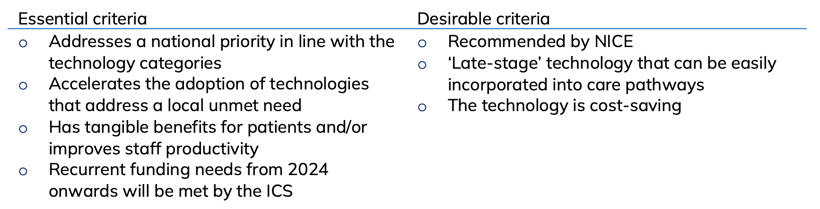
Health Technology Adoption and Accelerator Fund (HTAAF)
Health Technology Adoption and Accelerator Fund aims to support Integrated Care Systems (ICSs) to facilitate the adoption of technologies that can help cut waiting lists, speed up diagnosis, and deliver new and improved ways of treatment.
HTAAF supported devices, IVD tests, or digital products if the following criteria are met:
Health technology assessment
 Health technology assessment by NICE is very influential. NICE has several programs that could be applicable to in-vitro diagnostic tests.
Diagnostic Assessment Program
- A complex assessment program for diagnostic tests and technologies. The program focuses on both clinical and cost-effectiveness. Recommendations are not binding.
Medical Technologies Evaluation Program
- The program focuses on the identification and assessment of cost-saving technologies. It considers clinical effectiveness and cost analysis. Evidence requirements are lower compared to other programs at NICE. Recommendations are not binding, but they can be a substantial asset when promoting technology in England.
Early Value Assessment Program
- The focus of this program is to identify innovative devices addressing national needs, and to develop a suggestion for the early implementation of the new device and the evidence generation strategy. Recommendations are not binding.
France

France has a mandatory health insurance system in place (Bismarck model). The payers are three statutory health insurance schemes: General statutory health insurance scheme (the most important one), Agricultural statutory health insurance scheme, and Scheme for self-employed people.
Reimbursement is the key aspect of market access for IVD tests in France. HTA is not presented as a stand-alone concept and is included in the reimbursement pathway for IVD tests. France also has two innovative payment schemes relevant to IVD tests.
Reimbursement
In public hospital settings in France, there is no specific reimbursement framework for IVD tests. The costs of the IVD tests are covered within the DRG tariff for the primary medical procedure. Laboratories are funded using a global budget principle.
In private, for-profit hospital settings, but also in ambulatory settings, IVD tests are reimbursed via a fee-for-service mechanism via the Nomenclature of Medical Biology Procedures (Nomenclature des Actes de Biologie Médicale, NABM).
 Reimbursable IVD tests should be explicitly included in the NABM, which is the ultimate reimbursement goal for IVD tests in France. Each test has a nationally defined cost weight (points), which can be translated into euro amount used for reimbursement in outpatient settings and private for-profit hospitals (in addition to the DRG tariff).
The creation of novel reimbursement codes for IVD tests is proposed by clinical societies and stakeholders of the system (e.g., French High Authority for Health (HAS), insurance schemes) each year. Since the start of the 2024 submission campaign, manufacturers can also submit their applications. The first step of the code creation involves health technology assessment by HAS, while the ultimate reimbursement decision is made by the National Union of Health Insurance Funds (UNCAM). It typically takes 3-5 years to introduce a new NABM code, depending on the level of evidence available.
The NABM includes only well-validated tests. Significantly innovative tests with insufficient evidence for registration in the NABM List are first included in the RIHN framework of innovation funding, which is described in the following section.
Innovative Payment Schemes
France has several innovative payment schemes for medical technologies, which give an opportunity for early access to the French market. Two of those schemes are relevant to IVD tests, and they are listed below.
RIHN and Supplementary Lists
- The objective of the framework of innovation funding via the List of biological and anatomocytopathological innovative procedures outside the nomenclature (RIHN) is to provide temporary funding for innovative in-vitro diagnostic tests until evidence is sufficient to incorporate them into the NABM. This is a scheme relevant exclusively to IVD tests;
- Funding of the tests under the RIHN is provided from the budget for research and innovation (MIGAC, the sub-budget of MERRI G03), which is distributed to hospitals by the Ministry of Health;
- Tests in the RIHN are always paid on a fee-for-service basis (that is, even in public hospital settings, they are not covered by the DRG tariff). However, in practice, as the budget that each hospital receives for the provision of RIHN tests is rarely sufficient to cover the costs of the necessary number of tests, the real amount of money the care providers receive is lower than the official RIHN tariff;
- Once evidence is collected during temporary coverage, the test can be evaluated for inclusion into NABM List;
- Since RIHN was established, only a limited number of tests were transferred into NABM (for limited indications) as the process was poorly defined and, thus, inefficient. However, in 2023, the reform of this innovation framework was announced, and in the spring of 2024, the authorities explained how this reform will occur. The list of tests previously funded via RIHN 1.0 (called LAHN) is now subject to “cleaning up” via evaluations by the HAS. Cleaning the current LAHN will allow for the financing of truly innovative tests patients need;
- In addition, the authorities launched the registration process for innovative tests in the new RIHN 2.0 framework. Within the new framework, the evaluation by the HAS will take place, and the process of evidence collection needed for making a decision for regular reimbursement is clearly defined.
Forfait Innovation (national innovation funding)
- The objective of the program is to provide early support for breakthrough innovation and bridge serious evidence gaps simultaneously;
- The pathway includes a government-cosponsored study. The budget comes from three sources: the Ministry of Health (experimental arm), regular statutory health insurance (control arm), and an applicant (study infrastructure). In the process, the applicant (manufacturer) develops an application submitted to the Ministry of Health and the National Authority for Health (HAS). After evaluation and negotiations, the funding can be granted.
Germany

Germany has a statutory health insurance system (Bismarck model). The main payers in the system are statutory and private sickness funds.
Reimbursement is the key aspect of market access for IVD tests in Germany. HTA is almost exclusively limited to assessments by IQWiG in relation to the creation of outpatient reimbursement codes. Germany also has two innovative payment schemes that can be applicable to IVD tests.
Reimbursement
In hospital settings in Germany, there is no specific reimbursement framework for IVD tests. The costs of IVD tests are covered within the DRG tariff for the primary medical procedure. Laboratories are funded using a global budget principle.
 In outpatient specialist and ambulatory settings, IVD tests are reimbursed via a fee-for-service mechanism via the EBM (Uniform Evaluation Standard) catalog, which applies to approximately 90% of the German population (the remaining part is covered by private insurance, which uses the GOÄ catalog as a basis for reimbursement of outpatient services). A code is assigned to every procedure in the EBM catalog. The associated cost weight points are multiplied by the national base value (Orientierungswert) to determine the reimbursement tariff.
The introduction of a new EBM reimbursement code is the ultimate market access pathway for IVD tests in the public sector in Germany. The key reimbursement stakeholder for IVD tests is the Evaluation Committee (Bewertungsausschuss), which evaluates the submitted applications and makes final reimbursement decisions regarding most IVD tests in Germany. The process typically lasts 1.5-2 years.
In case of significantly innovative diagnostic (including IVD tests) and treatment methods delivered in outpatient settings, the method must undergo a thorough HTA by the Institute for Quality and Efficiency in Healthcare (IQWiG), after which the Federal Joint Committee (G-BA) develops a separate reimbursement decision. This process typically lasts around 2-3 years, although it can take up to five years, depending on the evidence situation. The G-BA reimbursement decisions are the basis for the tariff setting and inclusion in the EBM catalog) by the Evaluation Committee (Bewertungsausschuss).
Innovative Payment Schemes
Germany has several innovative payment schemes for medical technologies, which give an opportunity for early access to the German market, but also to generate evidence missing for obtaining regular reimbursement. Two of those schemes are relevant to IVD tests, and they are listed below.
Government-co-sponsored studies according to the §137e of the German Social Code Book V (Erprobungsstudie)
Co-funded studies in Germany are regulated in §137e of the Social Code Book V (SGB V). The framework applies to diagnostic or therapeutic methods that show a potential medical benefit but for which available evidence is not sufficient to decide on inclusion as a benefit within statutory health insurance.
Co-funded studies can be induced through direct applications by manufacturers (§137e (7) SGB V) or in the process of a method evaluation by the Federal Joint Committee (G-BA) as part of the funding process described in the previous section.
While the evidence is collected, a note is made by the G-BA Directive on ambulatory care methods specifying the terms of use of the method until a final assessment is made.
The Innovation Fund of the Federal Joint Committee (Der Innovationsfonds beim Gemeinsamer Bundesauschuss, G-BA)
The G-BA Innovation Fund provides resources for innovative models of care and healthcare research on existing care models in the form of pilots before the broader implementation. The focus is on enhancing the cooperation of healthcare stakeholders in various settings (ambulatory and hospital). In 2024, this framework became permanent.
This framework is applicable predominantly to non-med-tech interventions (optimisation of processes, intersectoral cooperation, psychological support, etc.), but also to medical technologies, including IVD tests, that can improve the current organization of care (for example, preventive testing, precision oncology testing, updates of testing process in the existing clinical guidelines).
Italy

Italy has a National Healthcare System, which is based on general taxation.
Reimbursement is the key aspect of market access for IVD tests in Italy. Health technology assessment plays a certain role in the adoption of medical technologies at the regional and local levels.
Reimbursement
In hospital settings in Italy, there is no specific reimbursement framework for IVD tests. The costs of IVD tests are covered within the DRG tariff for the primary medical procedure (in case the DRG, and not the global budget payment mechanism, is used in a particular hospital). Laboratories are funded using a global budget principle.
 In ambulatory settings, IVD tests are reimbursed via a fee-for-service mechanism via the regional nomenclatures of reimbursable services.
The document that defines the guaranteed healthcare services to Italian citizens is called the Essential Levels of Care (LEA document, 2017). Its Annex 4 (LEA catalog) contains an exhaustive list of outpatient services (including IVD tests) guaranteed to the Italian population with the national benchmark tariffs, determined by the Ministry of Health on the basis of the LEA catalog.
Regions (n=21) have their own nomenclatures of outpatient services with tariffs, which are used for actual reimbursement of outpatient services and IVD tests in ambulatory settings. These nomenclatures are based on the services and tariffs from the national LEA catalog. However, the regions have the right to introduce other (extra-LEA) services in their regional nomenclatures and also to adjust the reimbursement tariffs (with 2024 national LEA reimbursement tariffs serving as a benchmark).
There are two possible pathways to obtain reimbursement for IVD tests in Italy. The first way is to include the new test in the national LEA catalog. While direct suggestions have been possible since 2019, the LEA catalog has not been updated since 2017. Thus, this pathway is inactive at the moment. The second possibility is to include the new service in the nomenclatures of individual regions. Regional pathways do not have structured approaches in all regions; a lobbying effort with the support of the local KOLs is required.
Health technology assessment
A broad network of regional, university- and hospital-based health technology assessment bodies exists in addition to the national HTA agency AGENAS. However, the HTA activities in Italy diminished, and only one regional agency has been active in recent years. Even in this region (Tuscany), no IVD tests were evaluated, although IVD tests were commonly evaluated by various regional agencies before 2019.
In 2017, the National HTA Program for Medical Devices was launched. The aim of the program is to inform reimbursement and adoption decision-making at all the decisional levels in Italy, from the national LEA commission (Commissione Nazionale LEA) to the regional healthcare authorities, care providers, and regional procurement units. The program became active in early 2024.
Spain

Spain has a regionalized healthcare system under the umbrella of the. National Health System (NHS). In total, 17 Autonomous Communities have autonomy in the organization and financing of health care services.
Spain does not have a functioning reimbursement model as hospitals and laboratories typically mostly receive a global budget to provide services within the agreed scope. Genomic and genetic tests that are guaranteed nationwide are included in the Common Catalog of Genomic and Genetic Tests. Health technology assessment plays a certain role in the adoption of medical technologies at the regional level.
Payment model
There is no functioning reimbursement system for public healthcare providers. Hospitals and laboratories receive funding through a global budget from regional authorities.
As the key payment model for healthcare services is the global budget, medical device and IVD companies typically have no market access barriers and proceed with the adoption of novel tests by care providers.
In early 2024, the Common Catalog of Genetic and Genomic Tests (Catálogo Común de Pruebas Genéticas) of the NHS was introduced. This Catalog defines the list of genetic and genomic tests that are explicitly guaranteed nationwide (for specific indications). This is the key market access activity since 2024. Prior to the introduction of the national coverage framework, individual Spanish Autonomous Communities would make regional coverage decisions for significantly innovative and expensive (genetic or genomic) tests.
Health technology assessment
Health technology assessment is implemented at national (Instituto de Salud Carlos III, ISCIII), regional (in Andalusia, Aragon, Basque Country, Canary Islands, Catalonia, Galicia, and Madrid), and hospital levels in Spain.
Recommendations of HTA can have some impact on the adoption of technologies at the regional level and procurement decisions