


icosiMED is developing a first-in-class oral therapy that addresses large unmet needs remaining in the obesity market even after GLP-1s.
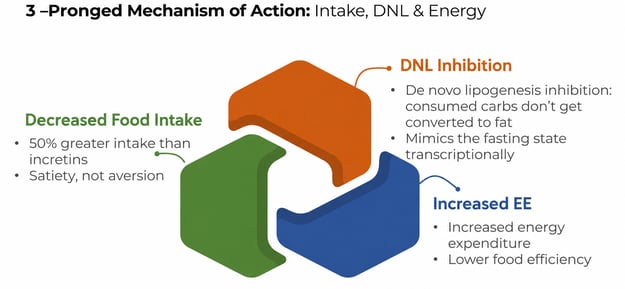 GLP-1 receptor agonists, the drug class that includes semaglutide and tirzepatide, have turned obesity treatment into a mainstream conversation and made weight loss one of the most valuable categories in pharma. They have not solved two critical problems: 1) most people stop taking them, and when they do, much of the weight comes back and 2) they don’t work for everyone, so patients need more options. icosiMED is developing icos167, a small molecule designed to be taken as a once-daily pill. It addresses metabolism with a 3-pronged strategy: decreased food intake, inhibition of de novo lipogenesis, and increased energy expenditure.
The Yo-Yo Trap GLP-1s Haven't Fixed
Nearly three in four U.S. adults (73.6%) had overweight or obesity in the most recent estimate from the CDC, based on 2017-2018 survey data. Most people who start a GLP-1 for weight loss do not stay on it. A Prime Therapeutics analysis of commercially insured patients found that only 15% were still taking the drug after two years, meaning 85% had stopped, and that 8% remained after three years. In the STEP 1 trial extension, people who came off semaglutide regained about two-thirds of the weight they had lost within a year of stopping.
The weight that does come off is not all fat. About 25% of the weight lost can be lean mass, including muscle. In our preclinical models, the weight regained after stopping treatment was entirely fat (see figure below). Large pharma companies are pursuing next-generation obesity assets to close these gaps, including programs still at the preclinical stage.
As prices for GLP-1s have come down and insurance coverage has increased, side effects, primarily gastrointestinal effects such as nausea, have become the most documented reason patients quit. In a real-world survey of patients who stopped a GLP-1, nausea was the single most frequently reported reason ("made me feel sick," 64.4%), followed by vomiting (45.4%) (Sikirica et al., Diabetes Metab Syndr Obes, 2017).
A Different Target: Where the Calories Go
icosiMED's work focuses on how fat is made and used as energy.
Three decades of research by our co-founder has identified protein that plays a central role in metabolism. This target helps regulate de novo lipogenesis, the process the liver uses to turn excess carbohydrates into stored fat, through both insulin-dependent and insulin-independent pathways.
Blocking our target turns that process down. In preclinical models, inhibiting our target suppresses fat-building genes such as fatty acid synthase (FASN) and stearoyl-CoA desaturase-1 (SCD1), pushing the body's fat-making machinery toward a state that resembles fasting. Carbohydrates are still eaten, but more of them are burned for energy instead of stored as fat, which is the idea behind the company's tagline: "Eat what you love. Lose what you don't." Our target also controls the other side of the equation: the burning of fat for energy.
What the Data Show
We are fortunate in having human genetic proof of efficacy. People who are missing both copies of our target are lean with average BMI of 21.8 (n=46). Studies show that drugs with human genetic evidence are about 2.6 times as likely to succeed in clinical development as drugs without (Minikel et al., Nature, 2024). The role of this target on metabolism is further supported by mice bred without the target gene. These mice stay leaner than normal mice, have a lower abdominal circumference, and show reduced activity in the genes that drive fat production. They also have more muscle: knockout mice had greater muscle size and grip endurance and ran about twice as long on a treadmill. In lifespan studies, the knockouts lived roughly 40% longer than normal mice and remained more active in old age.
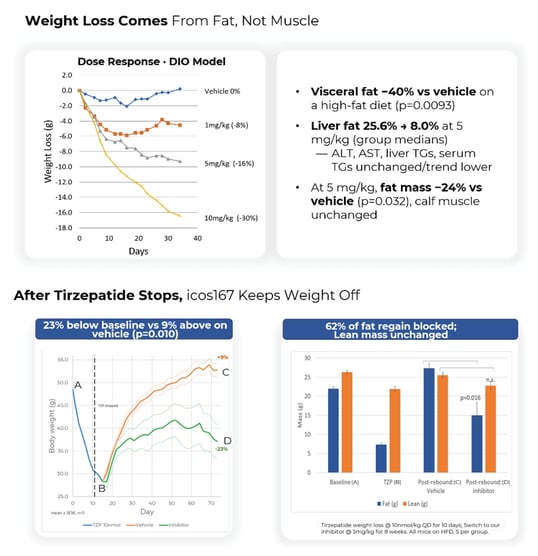 The next question was whether a drug could reproduce those effects. In mice fed a high-fat, high-carbohydrate diet, icosiMED's second-generation inhibitor, given by injection, resulted in a 30% decrease in weight at the highest dose tested, along with decreases in visceral fat and liver fat, with muscle remaining unchanged. The team has also shown that icos167 can blunt the rebound of fat gain after stopping GLP-1s.
In studies using obese mice on a high-fat diet, treatment with tirzepatide Mounjaro/Zepbound) resulted in a rapid weight loss. Stopping the drug led to rebound weight gain that overshot the original baseline by 9%, and all the regained weight was fat. By contrast, mice treated with icos167 retained 23% of the weight loss vs baseline and prevented 62% of the fat gained in the rebound phase, with lean mass unchanged. These preclinical results support developing icos167 both as a stand-alone weight-loss therapy and to prevent weight regain after GLP-1s are stopped.
In another important milestone, the team has shown that icos167 works on different areas of the brain than GLP-1s, which have been shown to act primarily on nausea centers in the hindbrain. By contrast, icos167 acts primarily on the hypothalamic regions that control food intake and energy metabolism.
One Molecule, Several Markets
Human weight management is the lead opportunity, and icosiMED sizes it in the billions of dollars. A once-daily oral small molecule fits the self-pay telehealth model that Ro, Hims & Hers and WW have built around weight-loss drugs, and small molecules generally cost less to manufacture than injectable peptides.
Our target opens up a cardiometabolic franchise opportunity. Obesity is only the lead indication, with confirmation of mechanism and preliminary tox work in 2027, followed by GLP-compliant toxicology studies and an IND filing in 2028 and FIH in 2029. We also have preliminary data that our target plays critical roles in metabolic dysfunction-associated steatotic liver disease (MASLD/MASH), hypertension and sarcopenia. In hypertension, a prior-generation inhibitor normalized blood pressure in hypertensive animals, selectively, with no effect when blood pressure was already normal. These subsequent indications can be addressed as extensions of our current program, essentially providing a pipeline in a pill.
icosiMED also sees a nearer-term market in pets. The company estimates that about 12 million obese dogs live in U.S. households earning more than $150,000 a year, and it believes that segment could support a separate deal. Because each market can be licensed on its own, the company has more than one route to a partnership. icosiMED currently has 6 pharma companies engaged in ongoing discussions for the human market.
The Road Ahead
Proceeds from this convertible note financing, which is part of a planned $5M seed round, will fund the next stage: expanded proof-of-concept work on the oral inhibitor, maximum tolerated dose and repeat-dosing studies, and an INTERACT submission (the FDA's channel for early, informal feedback) covering toxicology, manufacturing and the clinical plan. A critical efficacy study and a $10 million Series A would follow. icosiMED aims to reach partnership deals at the preclinical or Phase 1 stage, where large pharma has been buying obesity assets. An extensive composition-of-matter patent estate, with protection to 2040 before any patent term extension, along with additional filings in process, enhance the value of the asset.
Demand for GLP-1s shows how many patients want medical help with weight, and the discontinuation data show how few stay on today's drugs. icosiMED is developing an oral option for that gap, aimed at sustainable, muscle-sparing fat loss. Our asset's differentiated mechanism sets it apart in the competitive landscape, has drawn interest from pharma partners, and could give patients a much-needed alternative to current options.
To learn more about icosiMED, register for our December 9th webinar.